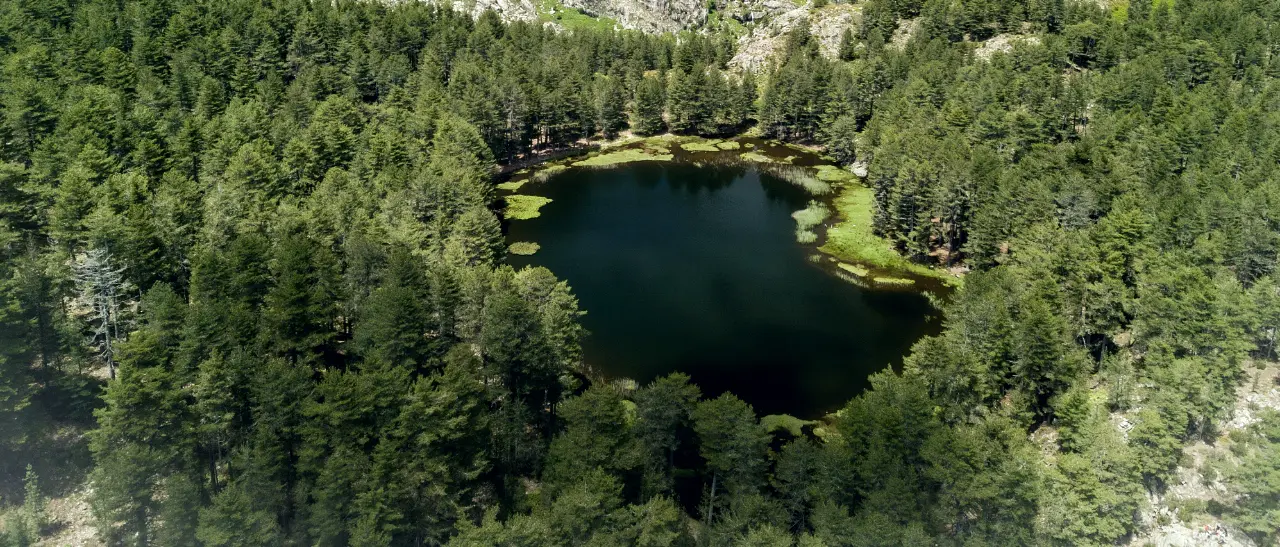
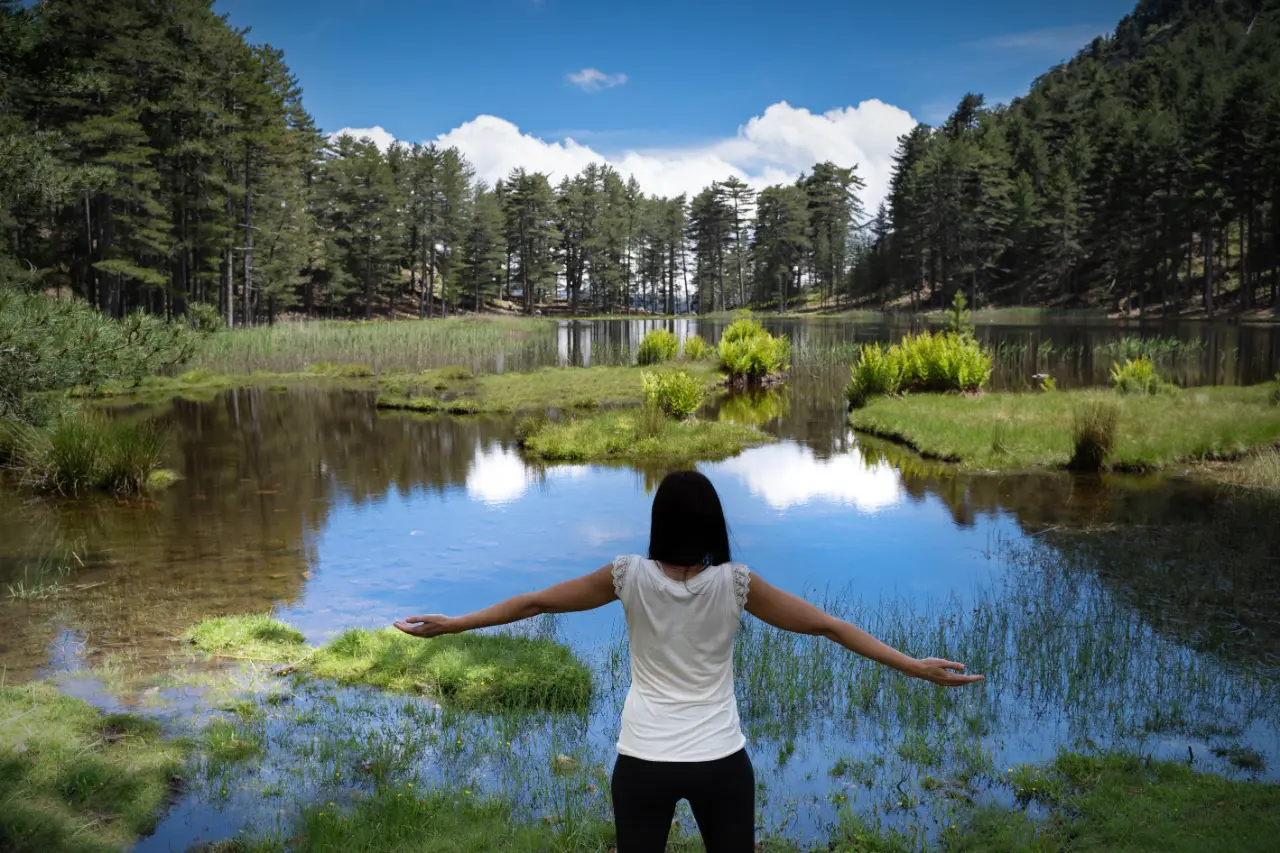
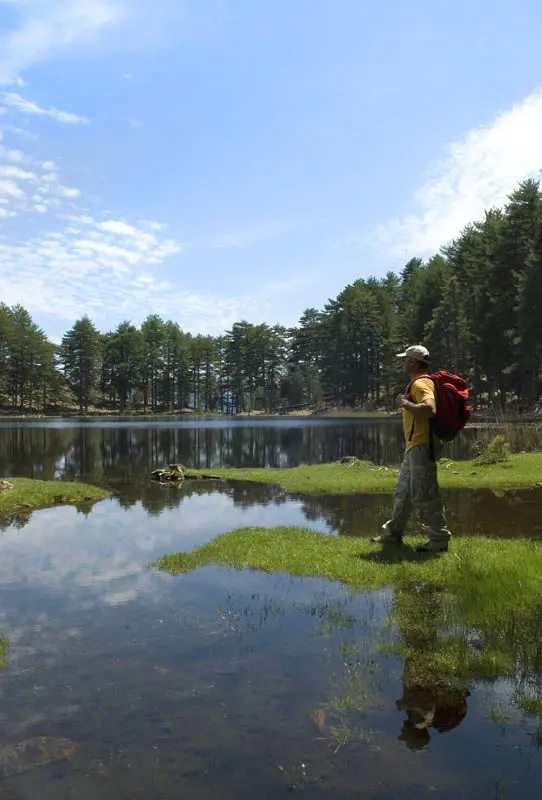
The lake of Creno, or Crenais the lowest of the Corsican lakes and the only wooded lake surrounded by laricio pines.
Located in the region of the Two Sorru, in the Monte Rotondo massif, the lake rises to 1310 metres above the villages of Guagno, Orto and Soccia. It is only accessible by footpaths.
With a maximum depth of 6 metres, the lake is fed by the Creno stream, which flows into the Fiume Grosso river, a tributary of the Liamone river.
Contents
Lake Creno
What is Lake Creno?
Corsica is the island of shepherds but it is also the island of lakes. If you want to see splendid stretches of water in the heart of the Corsican mountains, then you absolutely must go and see the Lake of Creno
Lake Creno is the only lake with a forest environment in Corsica. It is one of the lowest glacial lakes at an altitude of 1310 metres.
With a maximum depth of 6 metres, the lake is fed by the Creno stream, which flows into the Fiume Grosso river, a tributary of the Liamone river.
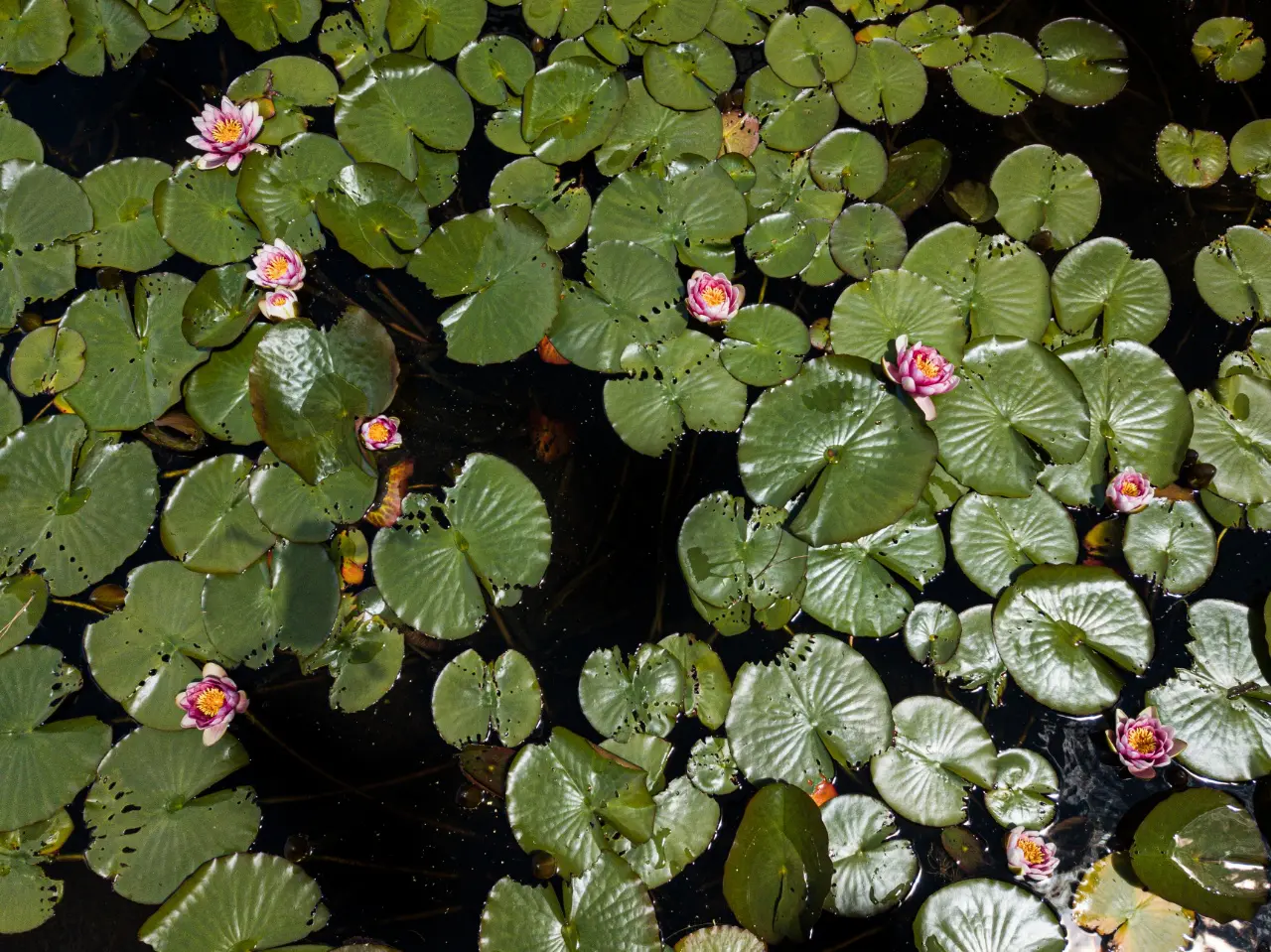
Its particularity is to host on its banks a small carnivorous plant, the Drosera, and to be flowered with non-endemic water lilies in season. This 2 hectare lake is a mountain lake, which is surrounded by laricio pine forests (priority habitat). The Creno lake is acidic and typical of peat bogs located in a forest environment, it is surrounded by stands of laricio pine, it is the only one in the Corsican mountains to be located in a forest environment and therefore to correspond to this habitat. The water of this lake has an acid pH of 6.5 and a high silica content. This habitat only exists in Corsica at one site: Lake Creno in the southern part of the Rotondo massif, in the commune of Orto.
This place is rather atypical compared to the lake landscapes usually found in Corsica.
It's so different from other lakes that you'd think you were in Quebec!
It is also very original because of the presence of carnivorous plants, the drosera, on islands of sphagnum moss. The palynological interest is also important because the great thickness of the peat has made it possible to carry out pollinological analyses (study of fossil pollens) which make it possible to retrace past climatic sequences.
Where is Lake Creno?
Located in the west of Corsica and in the region of the Two Sorru, more precisely in the Monte Rotondo massif, the lake culminates at 1310 metres above the villages of Guagno, Orto and Soccia. It is only accessible by footpaths.
A haven of peace in the heart of the forest about 70 km north-east of Ajaccio, not far from the picturesque village of Soccia. This typical remote mountain village, which exudes authentic Corsican character, is set against the backdrop of Monte Sant'Eliseo, where ancient granite houses are exposed with breathtaking views over the valley. Soccia is a truly charming village, so try to save some time for a stroll after hiking to Lake Creno. To reach Soccia, and especially the start of the trail, follow the winding roads through Sagone, Vico and Guagno-les-Bains. Or, coming from Porto, Evisa, you will have to pass the sevi pass, and cross Vico. Once in Soccia, enter the village, turn right when you see a small white sign handwritten "lac de Creno" and a little further on, you will have to turn left where there is another small green sign, be careful not to miss this turn because otherwise it's back for a tour of the village. Once you are at the top, you will arrive at two well laid out earthen car parks, overhung by a huge steel cross called Croce maio in Corsican. Ready to walk?
This place is rather atypical compared to the lake landscapes usually found in Corsica.
It's so different from other lakes that you'd think you were in Quebec!
Alone, with a partner or with a group of friends, discovering Lake Creno is one of the region's unmissable attractions.
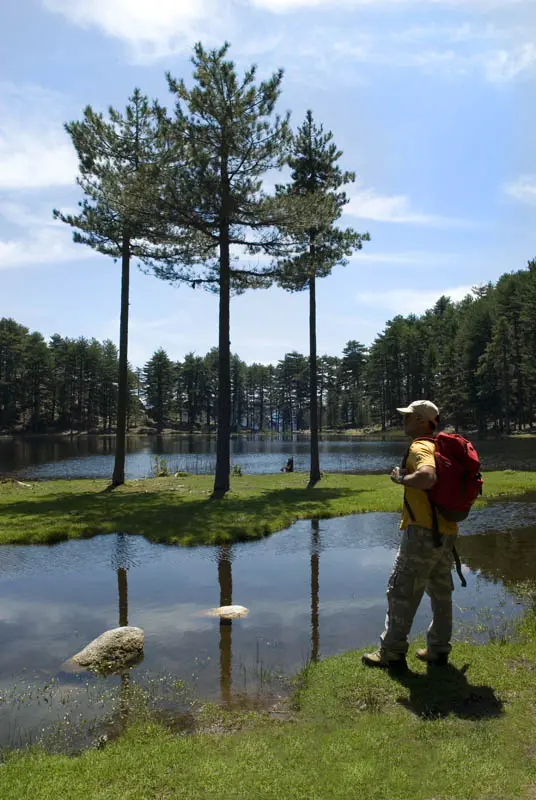
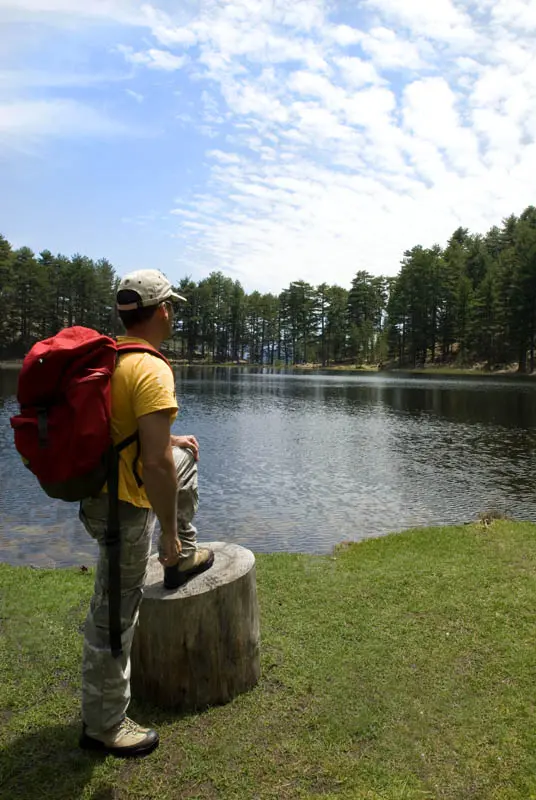
Reputed to be the easiest lake in Corsica to access, Lake Creno is the only lake on the island crowned with a forest of laricio pines.
This woody decor is complemented by the water lilies (in flower in early summer) which partly cover it, creating a truly unique and bewitching decor.
This grandiose and charming lake is truly a lake apart from the others.
Its beauty, which is discovered at the last moment when the laricio pines open up on it, will enchant young and old.
It is also an idyllic place for a picnic break or a little nap. But swimming is not recommended and fishing is not allowed.


The history of Lake Creno
Shortly before the lake, visitors are often intrigued by an iron cross in poor condition. Few people know the history of this cross. It was erected as an incentive to pray that the devil would not return to the dark waters of Lake Creno. For since the dawn of time, a mysterious belief has earned the lake the name of Devil's Lake.
Legend has it that the devil once hid at the bottom of the lake, probably to escape once again from his great adversary, Saint Martin. He was driven out by the prayers of a holy man, who drained the lake of all its water. After the devil's escape, the lake returned to its normal water level. This legend comes from the fact that the lake has black water due to the belt of trees that surround it. Vade retro Satanas! From now on, the place, as evil as it is enchanting, is protected by Saint Eliseo, who has his pilgrimage chapel just above it, at an altitude of 1500 metres. Traditionally, the
The pilgrimage of Saint Elisée takes place on 29 August: the religious ceremony ends with an aperitif and a picnic on site or around the lake
But more seriously, the lake is of glacial origin and is classified as a green lake according to its biological "productivity
Green lakes are warmer, richer and more productive bodies of water. The surface temperature of the water is 15°C in summer and the ice cover is maintained for 6.5 months. The vegetation belt is more important than in the other Alpine lakes. The green colour of the water is due to organic matter. This type of lake is found mainly in the Corsican regional park (Creno, Nino, Bastabi lakes, etc.).
The legend of Lake Creno or Devil's Lake...
Legend has it that the devil once hid at the bottom of the lake, probably to escape once again from his great adversary, Saint Martin. He was driven out by the prayers of a holy man, who drained the lake of all its water. After the devil's escape, the lake returned to its normal water level. Now the place, as evil as it is enchanting, is protected by Saint Eliseo, who has his pilgrimage chapel just above it, at an altitude of 1500 metres. Traditionally, the pilgrimage of Saint Eliseo takes place on 29 August: the religious ceremony ends with an aperitif and a picnic on site or around the lake.
How to get to Lake Creno (by foot, by car, ...)
Rather easy, its ascent will be quick for the most athletic or simply gentle for the less trained (or those who drag grumpy teenagers behind them... But here again, we have a solution for you!)
There are several ways to access the site:
- on foot, from Soccia
- on foot, from Orto
- by donkey, from Soccia
Well, we don't really have a choice as to the means of transport to get to the start of the path that leads to the lake of Creno, it will be by the departmental road with a motorised or non-motorised vehicle, whether it is a motorbike, a car, a tourist bus or why not by bike. You can come via Sagone, Vico or via Evisa and the Sevi pass. It is in Vico that you will have to branch off and take the direction of Guagno, by the D23 until Soccia. On the other hand, when you arrive at the Croce Maio car park above the village of Soccia, you have the possibility of getting there by other means than walking.
The lake of Creno on foot
The path is only passable by pedestrians or pack animals and that's fine.
The hike to Lake Creno begins below a large metal cross on the car park above the village of Soccia. There is a big sign at the bottom of the path and you have to start where there is a concrete pipe sunk into the ground (in the season a working refreshment stand and a donkey and horse hire shop share the car park). The stony path starts, it is quite easy but climbs all the way, and the first part is the steepest. On the way, you can replenish your water reserves at the Funtana di a Veduvella, a fresh water spring. The path climbs gradually to end at 1340 m where the lake is located. It will take you about an hour and a half to reach the lake of Creno, and as every effort deserves a reward, at the bend in the path, this expanse of water, surrounded by larici pines, will surprise you in an almost mystical atmosphere. Creno is discovered at the last moment and the superb forest of laricio pines makes a beautiful crown.
The lake of Creno on horseback or on a donkey
Why not try a horse or pony ride? And a donkey ride, have you thought about it? Whether you are a horse riding enthusiast or simply want to discover nature on horseback, with family or friends, this activity is accessible to all. From the start of the trail you can rent a horse, a donkey or a pony. If you want to relieve your back of its baggage, allow your children to rest during the ride, it is the ideal companion: it leads the little ones in a well-paced walk and relieves them when they are tired. The parents walk with less luggage and the children can look after their companion without seeing the time pass. It is an opportunity to try an adventure while respecting nature. Let yourself be lulled by the horses' steps, admire the landscape and enjoy the fragrance of the maquis, which intoxicates you, you are already dreaming about it.
There are several ways to get to Lake Creno on foot. You can start from the villages of Soccia or Orto, which are not so far from each other, but the distance to reach it is not the same
Lake Creno by Soccia
To get there, take the direction of Sagone and Vico to reach the village of Soccia. The road is winding and in very bad condition inside the village. Follow the signs and take the junction in the centre of the village until you reach the plateau with the car park and the large cross that overlooks it. The start of the path is indicated by a wooden sign in front of the large water conduit. Less than 4 kilometres to reach the lake, which is partly frozen during the winter season. Yellow markers on the rocks, and 3 visible signs at the intersections encountered. The return journey is by the same route as the outward journey. No major difficulties on this trail. Avoid the fog in winter
Lake Creno by Orto
It is also possible to leave from the village of Orto for a longer version, about 3.5 hours round trip, which is even more magnificent. Be aware, however, that while the lake is surrounded by trees and is a welcome haven of peace and coolness in summer, the path to get there is rather open and it is important to remember to protect yourself from the sun (long-sleeved t-shirt, glasses and hat) and to bring something to keep you adequately hydrated. At the height of the summer, you will be well advised to set off at daybreak to avoid the midday heat peak.
Experienced hikers who find this hike "too easy" can continue on to the Sant Eliseo chapel, the Izzola sheepfolds or the Nino lake.


When to go?
(advice on seasons, days/months/times...)
Because of the early snowmelt, due to its low altitude, the Creno/Crenu lake is one of the first accessible in spring. It is also one of the shortest hikes in terms of walking time. But whatever the season, the lake is always beautiful, perhaps a little more so in spring when the water lilies (in flower in early summer) add to the wooded scenery, creating a truly unique and bewitching setting. Or in October when the maquis takes on its winter colours. In terms of timetable, on the other hand, you will have to leave early in the morning and return in the early afternoon. It is important not to linger as the clouds quickly cover the sky and can become threatening without warning. The weaker spring sun can give way to clouds and wind, and as the weather clouds over and the wind blows through the pines, the scenery immediately becomes less romantic! The lake quickly changes from a friendly and benevolent face to a chilly and threatening landscape. And this is where it becomes clear why it is called the Devil's Lake, "frightening even the most daring of visitors"!
Victim of its fame, the lake of Creno in period of holidays drains a good number of visitors and to ensure you a total serenity, the best is to leave in the early morning that will also guarantee you the place to park your vehicle. Indeed the car park, although well equipped and relatively large, has difficulty in absorbing the flow of visitors in season.
Where to sleep? (camping, hotels, camper vans, wilderness camping, gîtes, etc.)
The question of where to sleep in order to get closer to the start of the hike, or to rest after having done it, is legitimately raised. And there are several alternatives, the closest being the villages of Orto or Soccia, but you can also start from another corner of western Corsica, which will be a maximum of 2h30 away. As a sea and mountain destination, the West Corsica region offers accommodation for all tastes. From open-air hotels to residences, via a rented gîte, you will have the king's choice. Whether you want to sleep to the sound of the waves by the sea or in the heart of the forest, to admire a sunset or a starry sky, find the accommodation that suits you on our website


What can you see? (rocks, fauna, flora, towers, curiosities...)
The surface of the lake, which was built about twenty years ago, is partly covered with water lilies, creating an even more relaxing landscape in early summer.
In addition to the forest of Laricio pines, the lake is surrounded by small remarkable grasslands that develop on its shepherds' paths and are called pozzines.
It is in this particularly sensitive environment that a small, rare and protected carnivorous plant grows, the round-leaved Drosera, Drosera rotundifolia ssp. corsica. It is a protected plant on the whole national territory: collection, use and transport are forbidden.
The Creno Lake walk is accessible to all and immerses you in the typical Corsican landscape. Along the way, you will discover the typical flora and fauna of the Corsican maquis, and then, more specifically, when you reach the outskirts of Lake Creno.
Its special flora
Beautiful Italian immortals, terminal heathers, foxgloves, but also some chestnut trees and Corsican thyme cover the many rocks.
The surface of the lake, which was built about twenty years ago, is partly covered with water lilies, creating an even more relaxing landscape in early summer.
In addition to the forest of Laricio pines, the lake is surrounded by small remarkable grasslands that develop on its banks and are called pozzines.
It is in this particularly sensitive environment that a small, rare and protected carnivorous plant grows, the round-leaved Drosera, Drosera rotundifolia ssp. corsica. It is a protected plant on the whole national territory: collection, use and transport are forbidden.
All the grass you see on the lake are pozzines: wet grasslands established on peaty soils. These wetlands of the high Corsican mountains are recognised by the European Directive
"The pozzines of Lake Creno are remarkable, particularly because of the presence of particularly rare and protected plant species. The pozzines of Lake Creno are remarkable, particularly because of the presence of particularly rare and protected plant species.
Its wildlife
Known for its remarkable flora, the fauna is also well present, several species can be named such as: the Corsican nuthatch, the crossbill, the wood creeper, the Corsican salamander. Since the reintroduction of the Corsican deer in the region in 2009, a few individuals have been observed near the lake. It is not uncommon to come across free roaming pigs in October and November, they hunt down chestnuts, they love them!
What other activities? (hiking, boating, horse riding, cycling, craftsmen, producers...
In addition to beautiful photos and a good breath of fresh air, what are the souvenirs or activities you can do or bring back from your hike at Lake Creno?
The ride on horseback or on a donkey will be the occasion to make unforgettable photo reports and will be the object of frank laughter with our four-legged friends.
The Zoicu canyon is a river well known to canyoning enthusiasts. In two places (aheadl) it also offers beautiful natural pools to cool off in, after the hike to Lake Creno for example
A visit to the honey house located in the village of Murzo will allow you to bring back some sweets in your suitcase
The potter or the cutler will be happy to welcome you in their shop, just make an appointment.
And an artisanal ice cream tasting If you are tempted? so much the better, there are some excellent ones in Sagone, with our master ice cream maker
Another souvenir of Corsica: the fashion designers. Whether in the fields of beauty, decoration, clothing or jewellery, you will certainly find producers on the way back in small stalls, the opportunity to stroll through the villages to find the rare pearl


Is it free?
Yes, the trip to Lake Creno is completely free. No tolls, no paid parking, and parking is also free. However, a small piece of advice in season, you'll just have to arrive early in the season to be sure to find a place close to the starting point, because the car park, even if it's big, can't absorb all the visitors.
Where to eat?
At the start, a refreshment stand serves refreshments and also offers you something to eat. You can also have a picnic on the tables and benches provided around the lake for a lunch break.
Otherwise, in the village of Soccia, you will certainly find a good restaurant that will serve you specialities from our mountains. You will be able to taste charcuterie and good meat dishes; lonzu, coppa, prisuttu, saucisson... the good parts of the pig! but not only.... Sweet treats are also on the menu, often, desserts in Corsica are based on cheese like brocciu and chestnut flour, yum! As for fruit, clementine and citron are very popular, with myrtle to be enjoyed after the meal as a liqueur! In short, you will be spoilt for choice!


What kind of audience is this place for?
Don't forget that hiking in Corsica is hiking in the mountains.
It is essential to be well equipped, even for a so-called easy hike, with good shoes and warm clothes, and above all water. But the walk from the lake of Creno is almost for everyone and can satisfy everyone's desires in terms of activity
- Contemplatives:
If your aim is to remain focused on the route, on the pleasure of walking and discovering new horizons with each step, then the walk to Lake Creno is for you. Quiet, calm, the climb is gradual, but sustained, (without shade in the first part). The rest of the walk is on a superb path, well laid out and without danger, until the lake of Creno. Impossible to get lost, everything is well indicated, leave early to avoid the heat. About 2 hours of walking with a difference in altitude of 310m, almost within the reach of everyone, isn't it? On arrival, the place par excellence for contemplation: The natural and marvellous landscape, which even pushes us to meditation, so much the calm and the quietude surrounds it
- The families
If you're looking for what hike to do with kids in Corsica, this is it!
It is one of the most beautiful hikes in Corsica, starting from the village of Soccia, which is situated on a rocky spur at 650 m altitude, 70 km north of Ajaccio.
The path is pleasant and accessible to all. The climb at the start is the most difficult, then it gets a little steeper, and continues without shade (leave early in the summer) then the path rises through scrub and ferns. The end of the path is in the forest until you reach the lake, which is only discovered at the last moment.
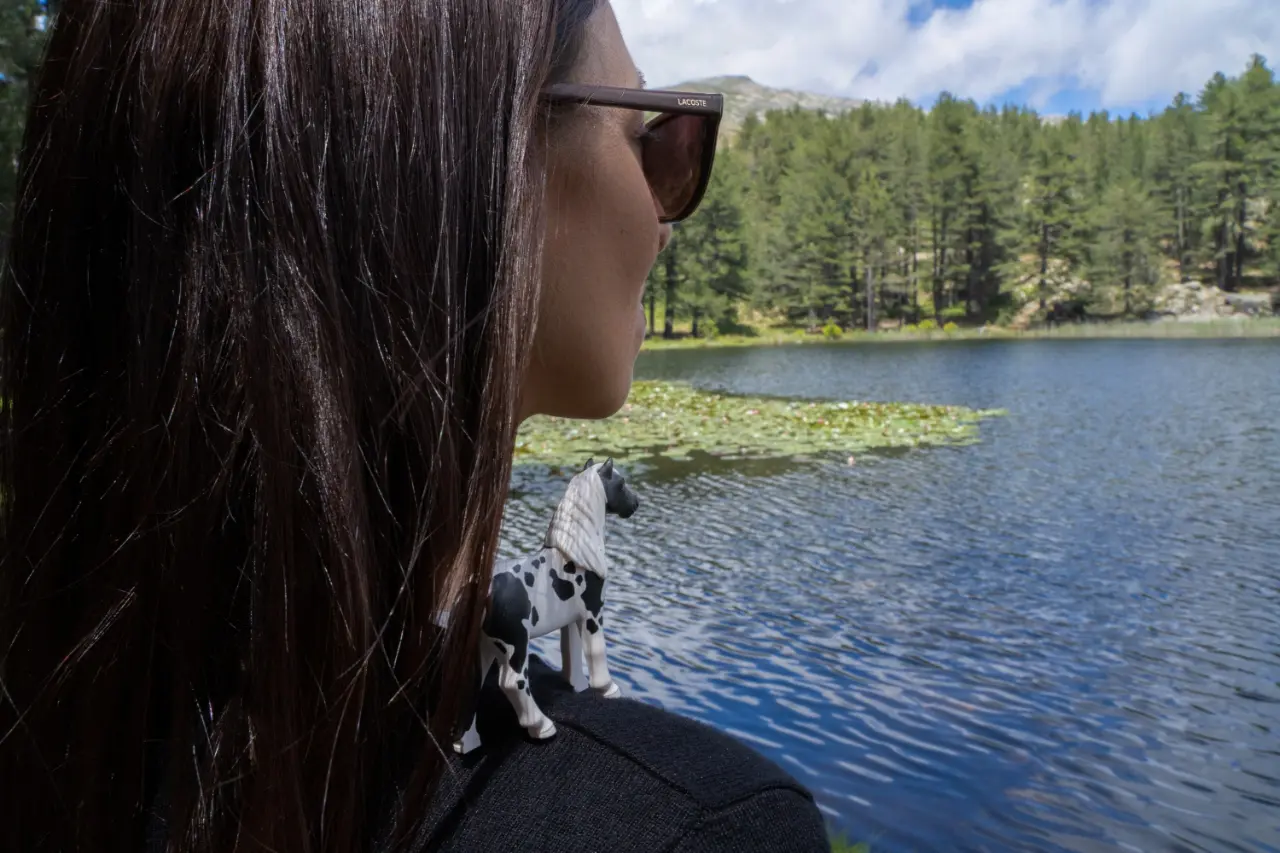
It will take you about 2 hours of walking to reach Lake Creno, your reward. The lake is covered with water lilies at the beginning of the season. Take time to enjoy the view!
During the season, you can rent donkeys from Lake Creno to roam the area. Your children will love it. This animal, known for its gentle way of life and its great calm, is the ideal companion for your little darlings. It will fill many lines on postcards sent to grandparents and will be the subject of beautiful selfie breaks with the little ones. Don't hesitate to double the walking time, especially with children, so that you can take plenty of breaks for drinks or snacks and make the most of the hike.
- Sportsmen and women:
The hike to Lake Creno is a so-called family or easy hike because of its short duration and low difficulty. It is very popular with tourists but not so much with performance-oriented hikers.
In fact, it is possible to lengthen the walk by going up to the Sant Eliso chapel or by climbing Sant'eliseu, that will add 2 hours, or by joining the Izzola sheepfolds that will make 1 hour more, or by prolonging on the GR20 via Bocca d'Acqua Ciarnente more than 3 hours, and by the Vaccaghia sheepfolds 4 hours, and for the more experienced you can go up to the Ninu lake with more 8 to 9 hours. Enough to satisfy your desire for a challenge if that is your goal.
- For lovers
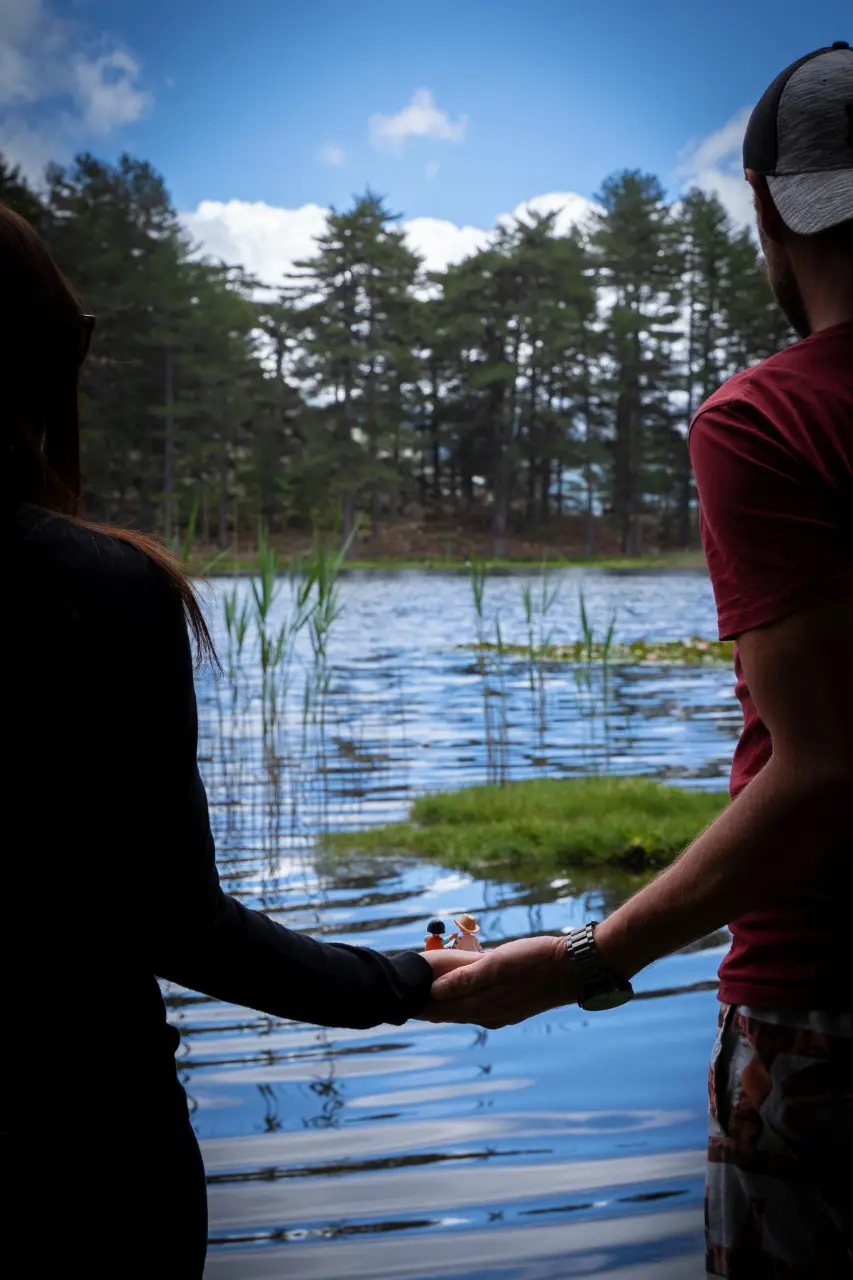
A holiday for two is so romantic. Nature lovers and lovers alike will be delighted by the arrival at the lake, the atmosphere is so calm and almost unreal. There is a mystical, almost supernatural aura. In summer, in addition to the reeds, numerous white and pink water lilies bloom on the lake. You can also admire the pozzines, which are lawns crossed by streams that soak them with water that they create water holes. What could be more beautiful with a lover than a landscape with a legendary aura? Now it's up to you to pull out all the stops...
Other: anecdotes, quotes, etc.
A haven of peace in the heart of the forest
This place is rather atypical compared to the other lakes that one generally meets in Corsica.
It is only after a few moments of getting used to it that one understands that the Creno lake is unique. This natural place is so special that it is difficult to believe you are in Corsica, it can remind you of Canada. And sometimes even elsewhere, when you look at the red and white water lilies that float on the surface of the water in summer. Like the reeds, they have been introduced here, and their acclimatisation, which has been perfectly successful, contributes to the reputation of this site, where batrachians and populations of aquatic birds such as grebes and moorhens thrive.